Review: Nitecore – EDC25
Introduction
As you know, Nitecore is a well-known name in the flashlight industry and the EDC series has become one of their most recognizable product lines for everyday carry users. The EDC25 is the follow-up to the EDC27, and while it carries a lower model number, it features a clear step-up in output, throw, and overall design. With a maximum output of 3,000 lumens, a flat form factor and a built-in USB-C rechargeable battery, there is plenty to talk about. Especially since I am using this particular model for quite some time.
As always, let’s start with the specs and get an overview for those in a hurry.
Overview of the EDC25
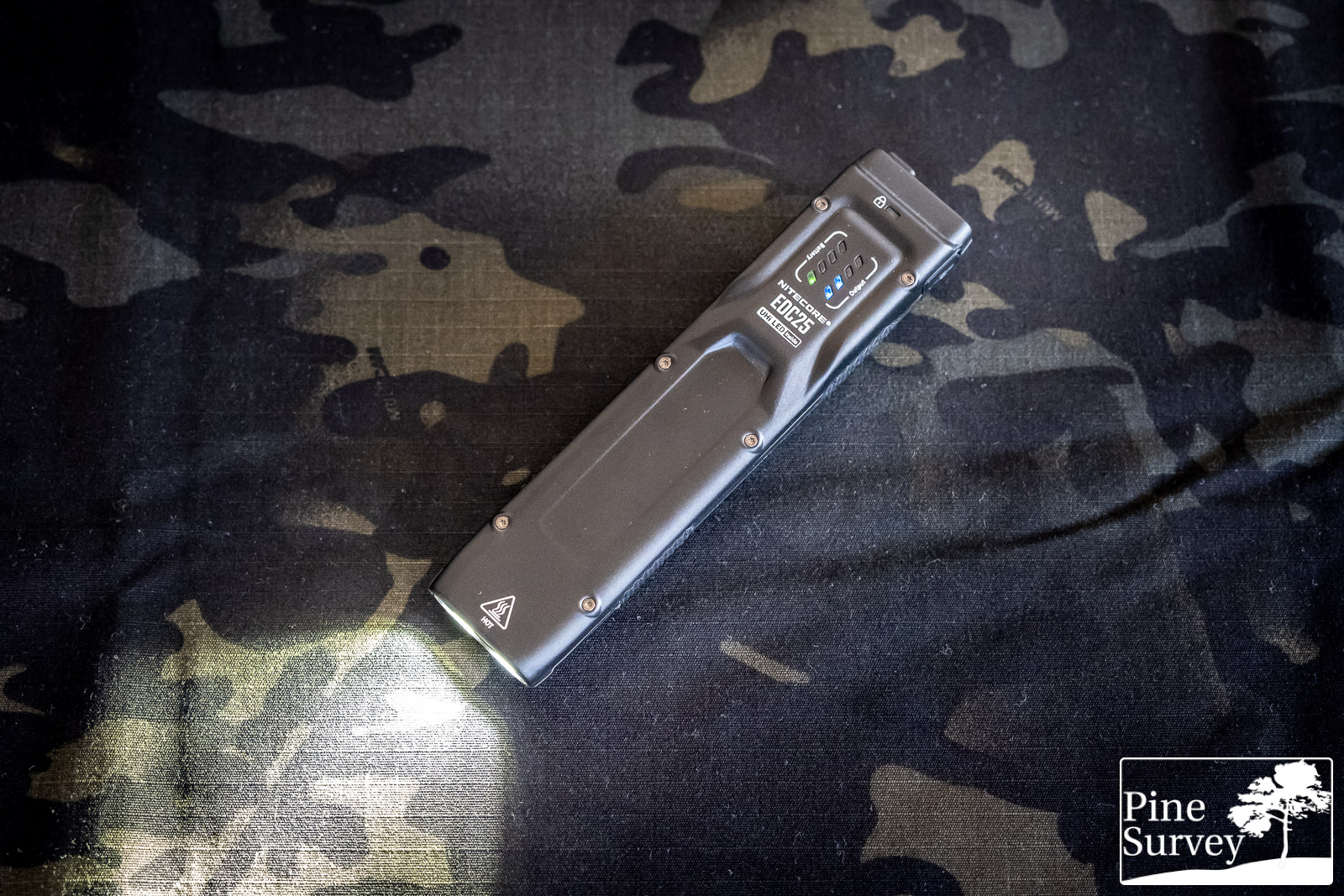
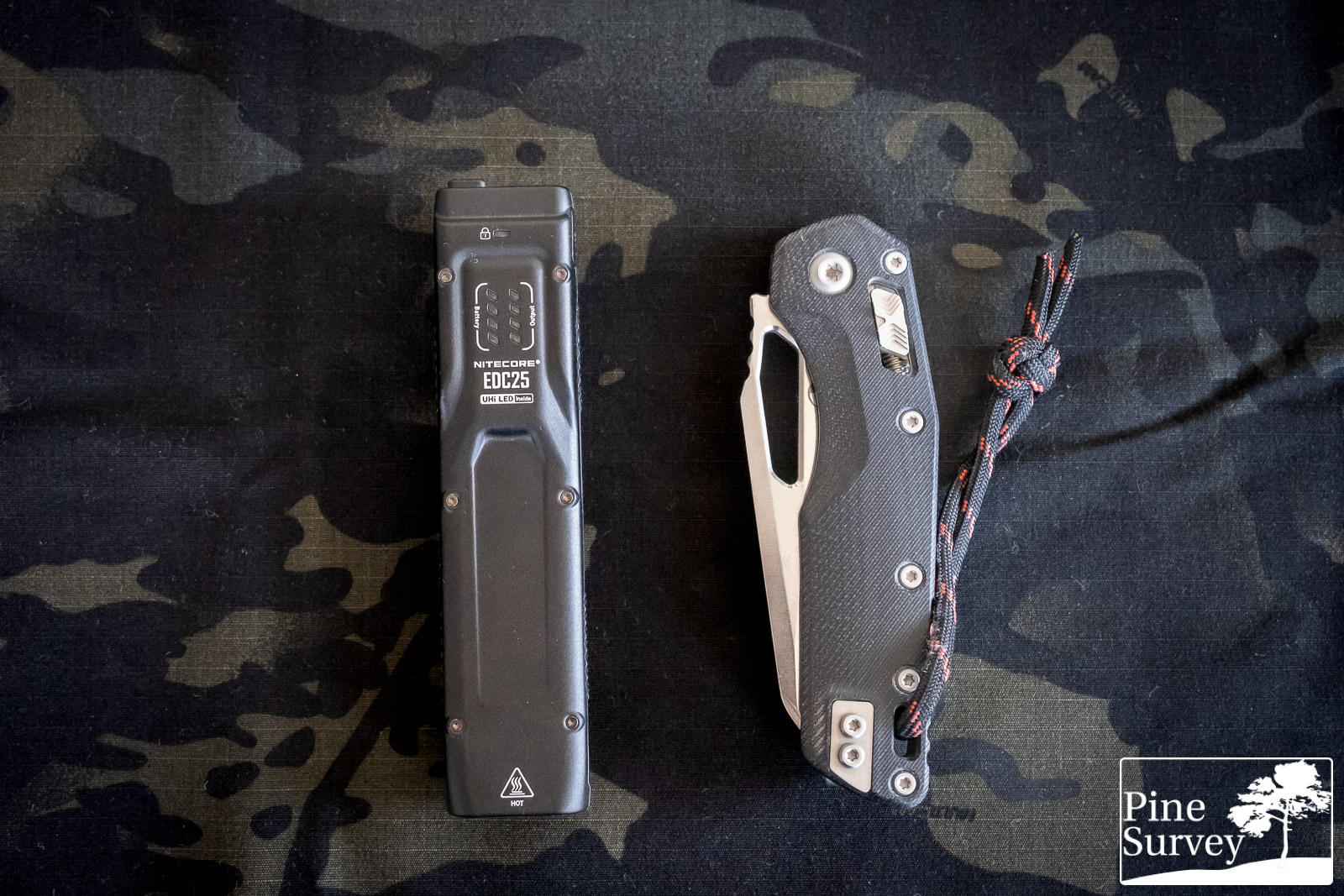
The EDC25 is a flat EDC flashlight that takes a different approach compared to the conventional cylindrical flashlights. At 136.3 mm in length and only 13.7 mm thick, it is closer in shape and size to a large pocket knife than a traditional lamp. It weighs in at 104 grams with the built-in battery, whith up to 3,000 lumen output.
The dual NiteLab UHi 20 LEDs are paired with a metal orange peel reflector. The 1,700 mAh Li-Po cell is charged via USB-C and provides runtimes ranging from 1.5 hours at the highest output down to 55 hours in the Ultralow setting.
Specs
- LEDs: 2 × NiteLab UHi 20
- Max Output: 3,000 Lumens
- Max Beam Intensity: 22,500 cd
- Max Beam Distance: 300 m
- Max Runtime: 55 h (Ultralow)
- Battery: Built-in 1,700 mAh Li-ion (Li-Po)
- Charging: USB-C (approx. 1.5 h at 5V/2A)
- Body Material: Aluminum alloy (HA III military grade) with carbon fiber reinforced polymer frame
- Length: 136.3 mm / 5.37 in
- Width: 31.4 mm / 1.24 in
- Body Thickness: 13.7 mm / 0.54 in
- Weight: 104 g / 3.67 oz
- Water Resistance: IP54
- Impact Resistance: 1 m
Construction of the Nitecore EDC25
The construction of the EDC25 is one of its most notable characteristics and directly responsible for both its light weight and its distinctive appearance. The front and rear shells are made from aluminum alloy with an HA III military grade hard-anodized finish, while a carbon fiber reinforced polymer frame forms the structural core of the body. Six sets of connector bolts hold the assembly together, resulting in a construction that should resist compression, twisting, and bending.
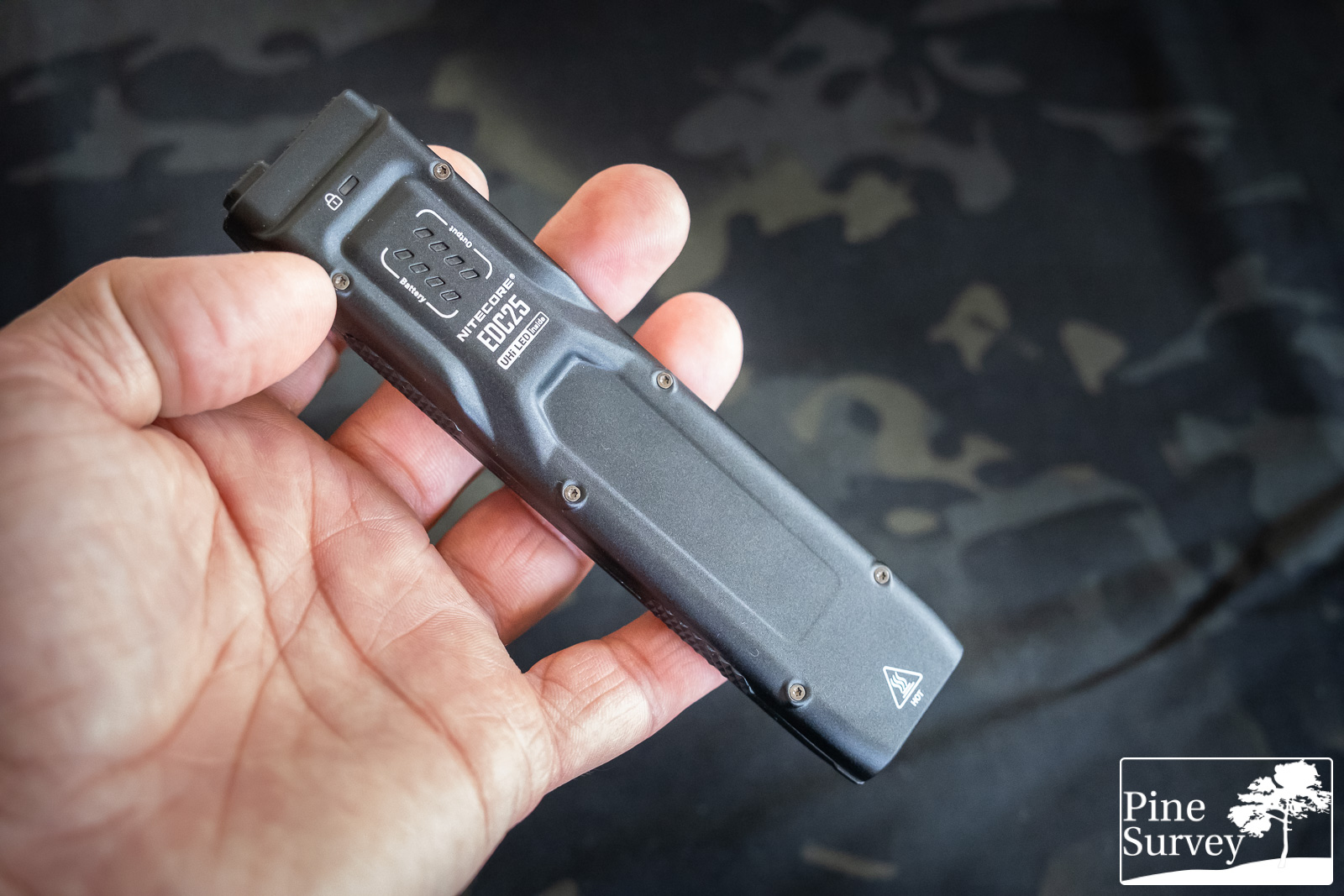
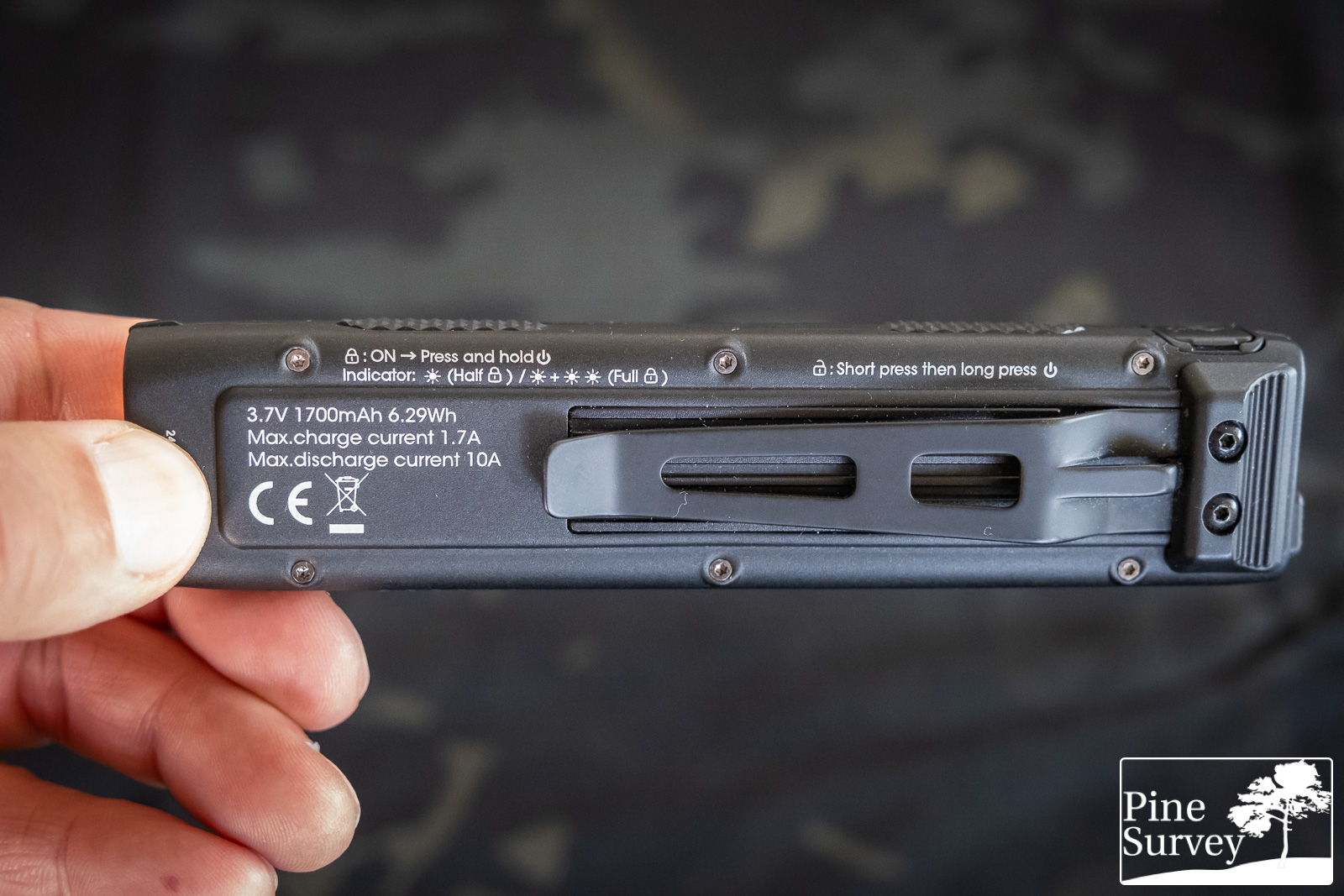
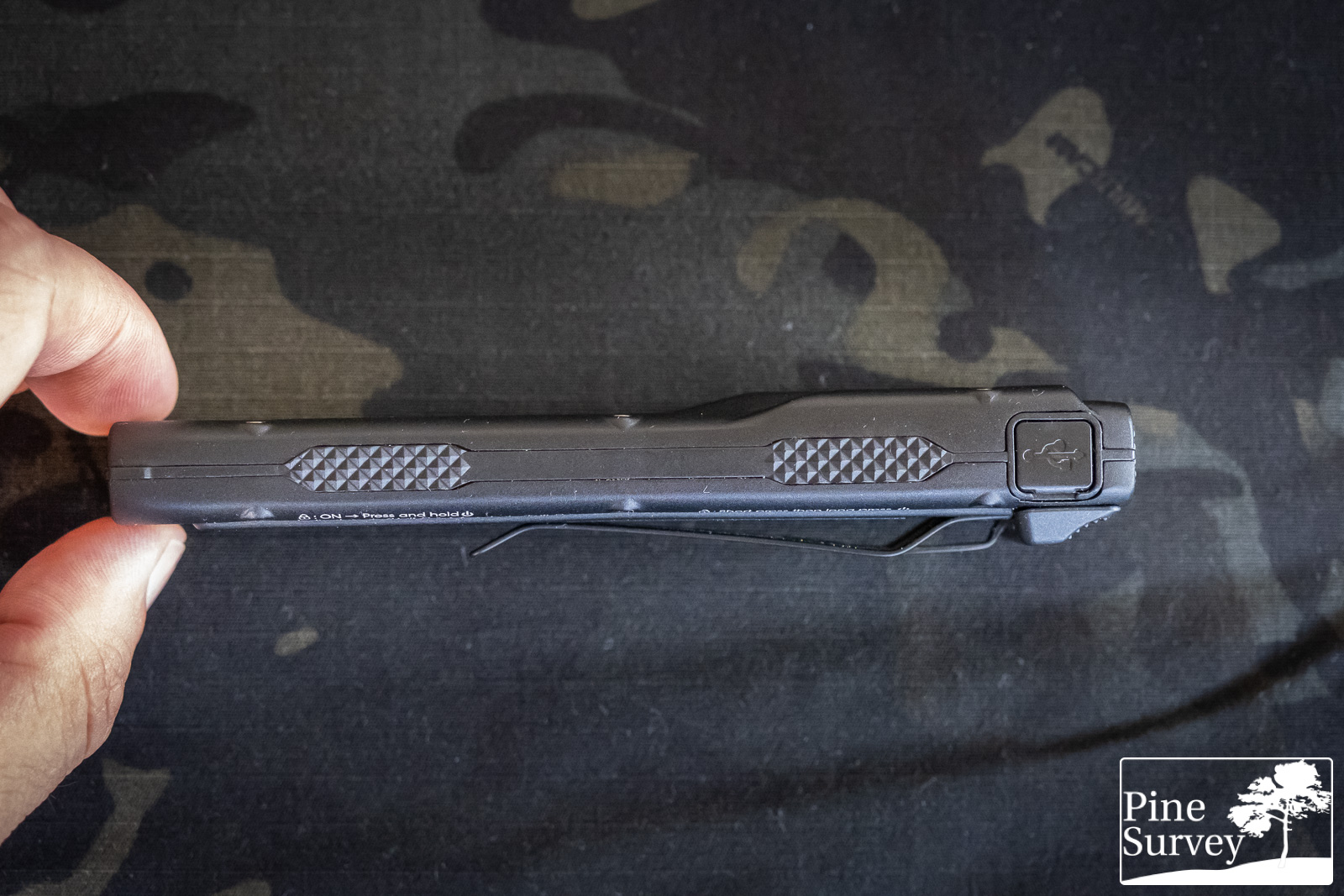
The hard-anodized finish is worth mentioning: it is resistant to scratches, sweat marks, and fingerprints, which is a practical feature for any piece of gear that is carried and handled frequently. The sides of the EDC25 feature a carbon fiber reinforced polymer material with a non-slip texture in four places, which provides a secure grip despite the slim profile.
The clip is made from stainless steel and runs over half the length of the lamp and is wide enough to be compatible with 550 paracord (4 mm / 0.16″). It can be removed if not needed, and the gap at the top of the clip doubles as a lanyard attachment point. A raised holder above the clip is designed to prevent accidental activation during carry.
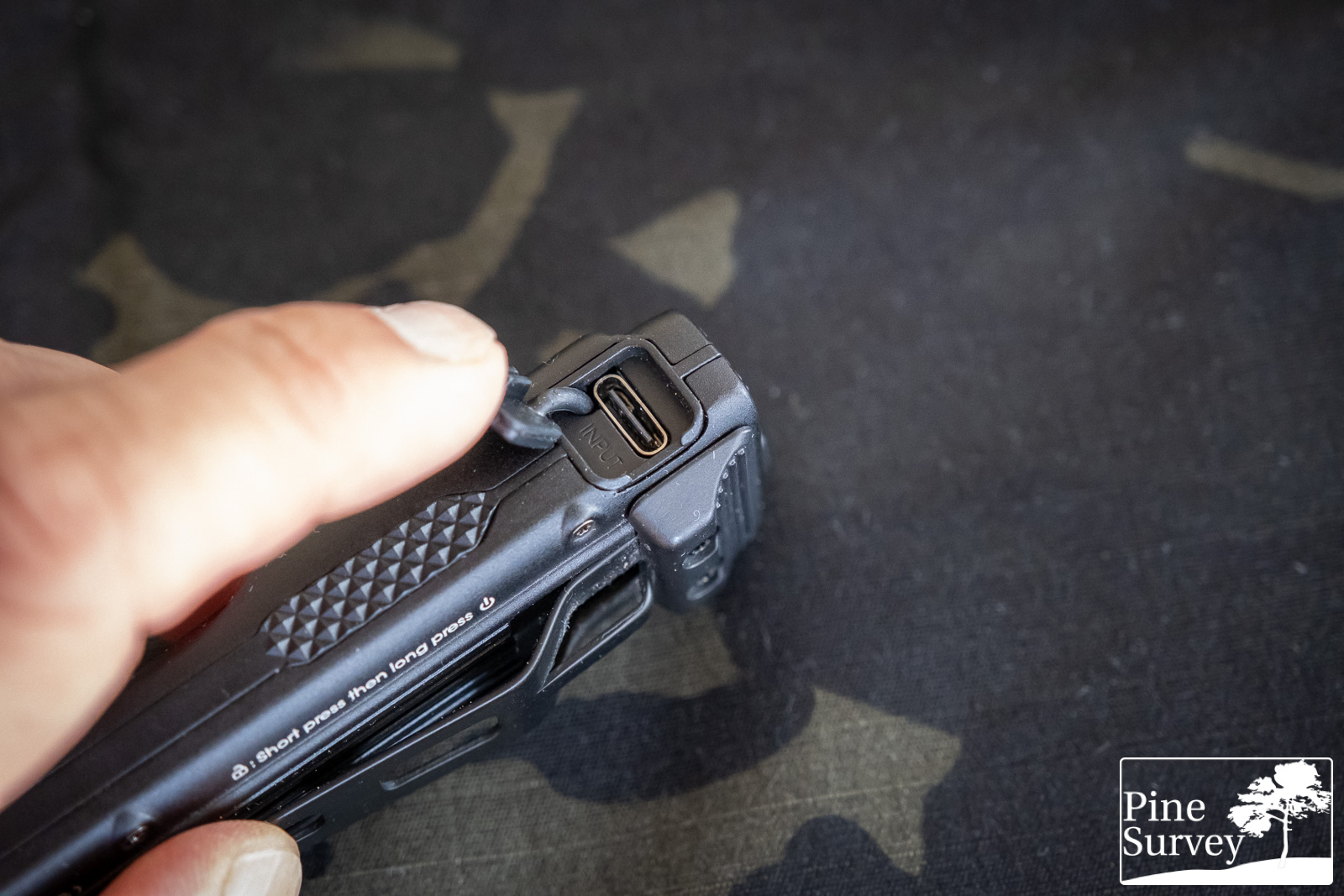
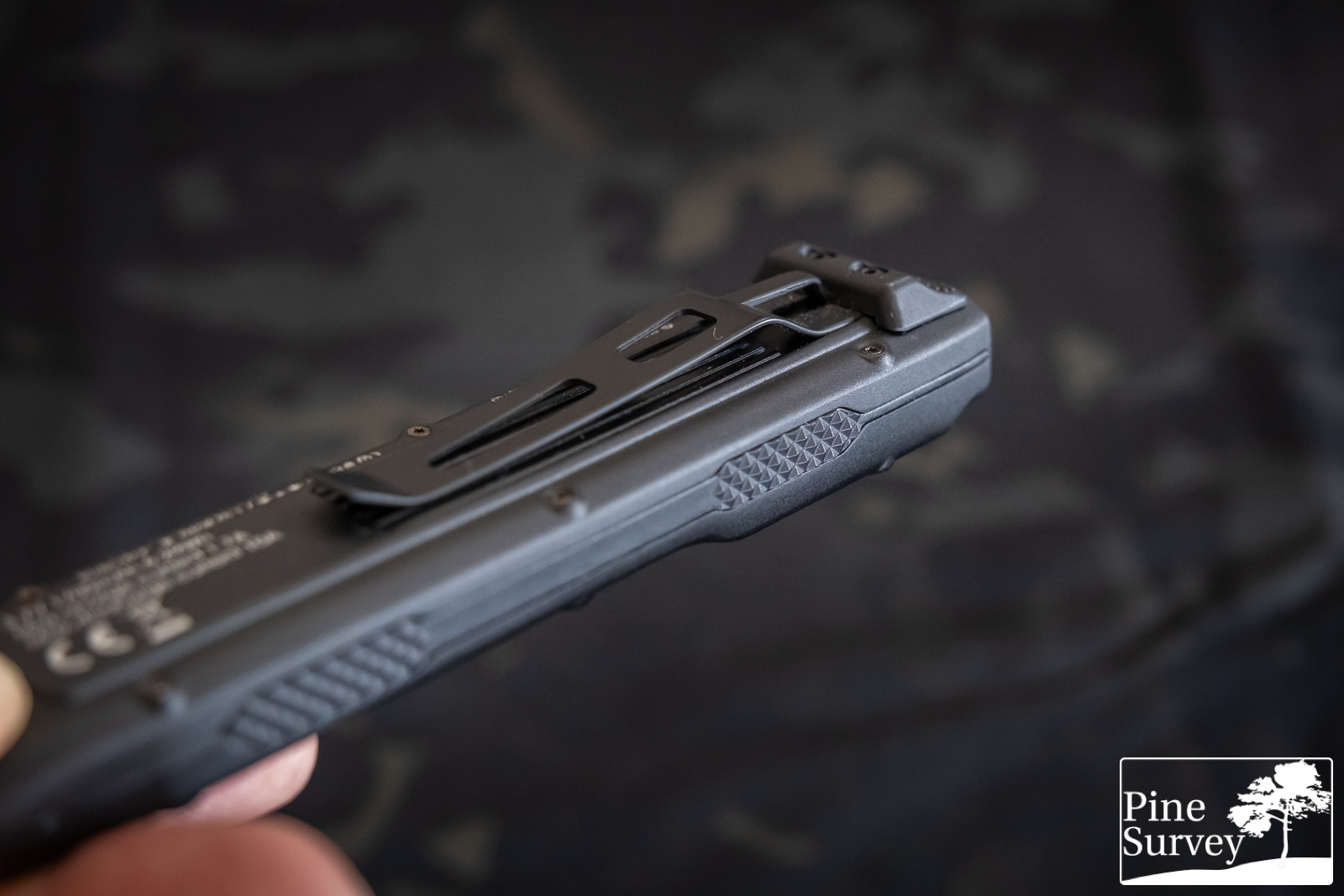
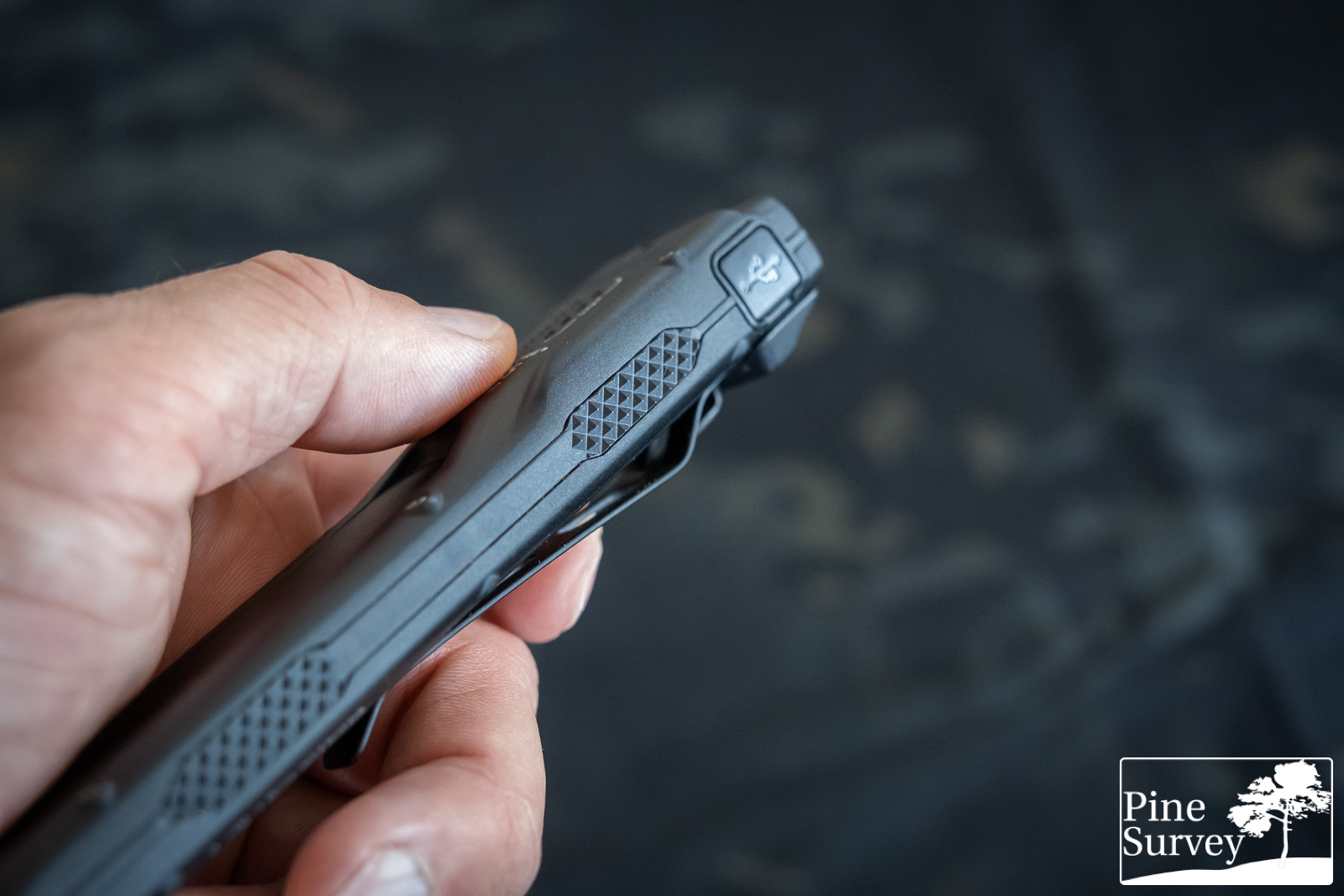
One aspect that should be noted clearly: the IP54 rating. This places the EDC25 at splash and dust resistance, but not full waterproofing. Compared to many flashlights in a similar price range, which often carry an IP67 or IP68 rating, this is a limitation worth keeping in mind depending on the intended use.
The Heat Dissipation Design
Given the thin profile and the high output, thermal management is an obvious challenge for the EDC25. Nitecore addresses this with what they describe as a semi-embedded heat dissipation structure that extends from the head almost to the tail of the lamp. The resulting heat dissipation area measures 1,897 mm², which is intended to conduct and disperse heat quickly despite the compact form factor.
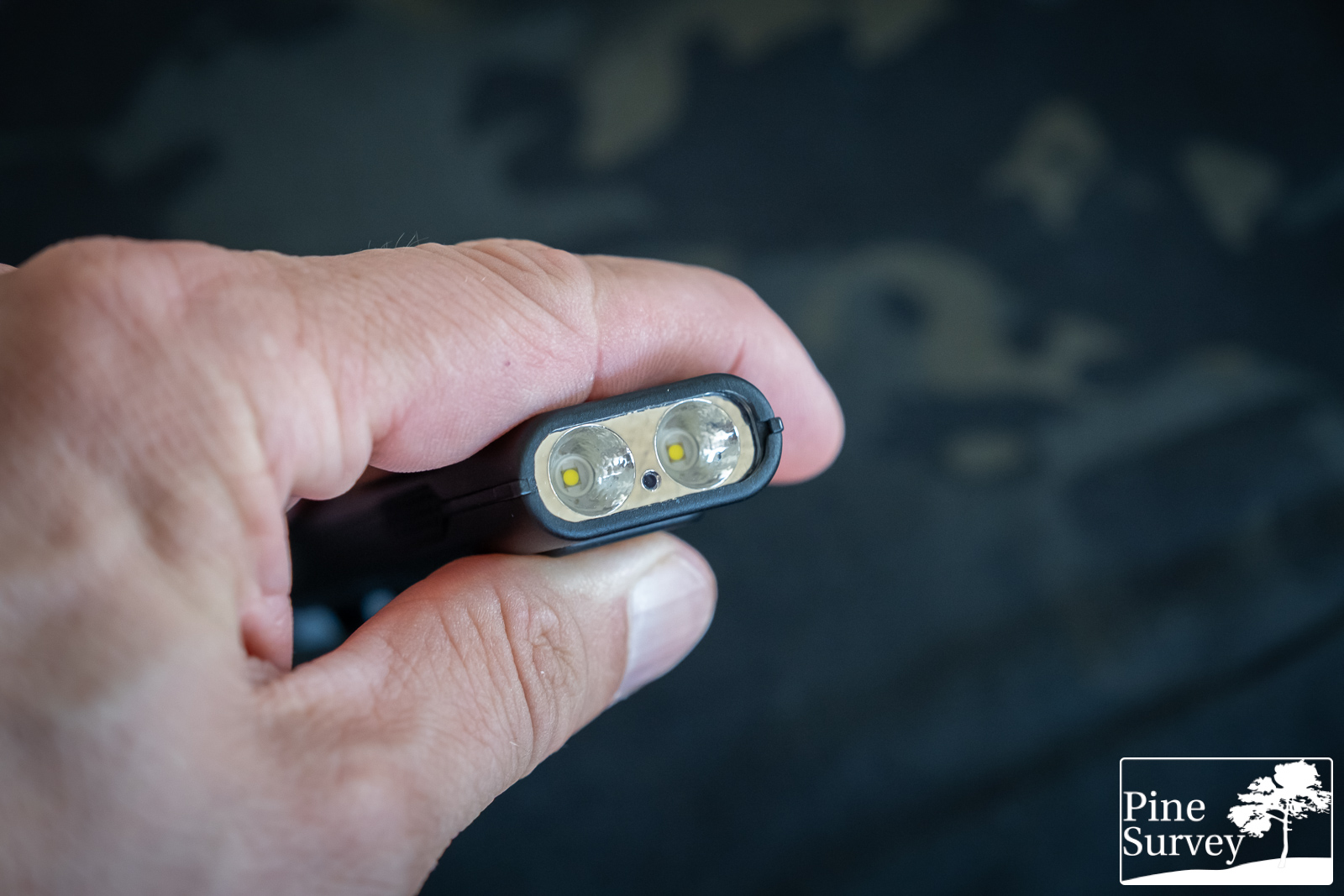
The lamp also incorporates Nitecore’s Advanced Temperature Regulation (ATR) module, which automatically regulates the output based on working and ambient temperatures in order to maintain optimal performance while preventing the LED from overheating. In practice this means the full 3,000 lumen output is available as a momentary or short-duration setting, not a sustained one, with the ATR stepping down the output as the lamp heats up.
Modes and User Interface
The EDC25 is operated by two tail-mounted electronic switches, which is consistent with Nitecore’s twin-switch approach used on several of their recent lamps. The primary switch is a two-stage power button: a full press turns the lamp on and off, while a half-press cycles through the four main brightness levels. The second switch is a customizable tactical button that provides direct access to either Turbo or Strobe, depending on the user’s preference.
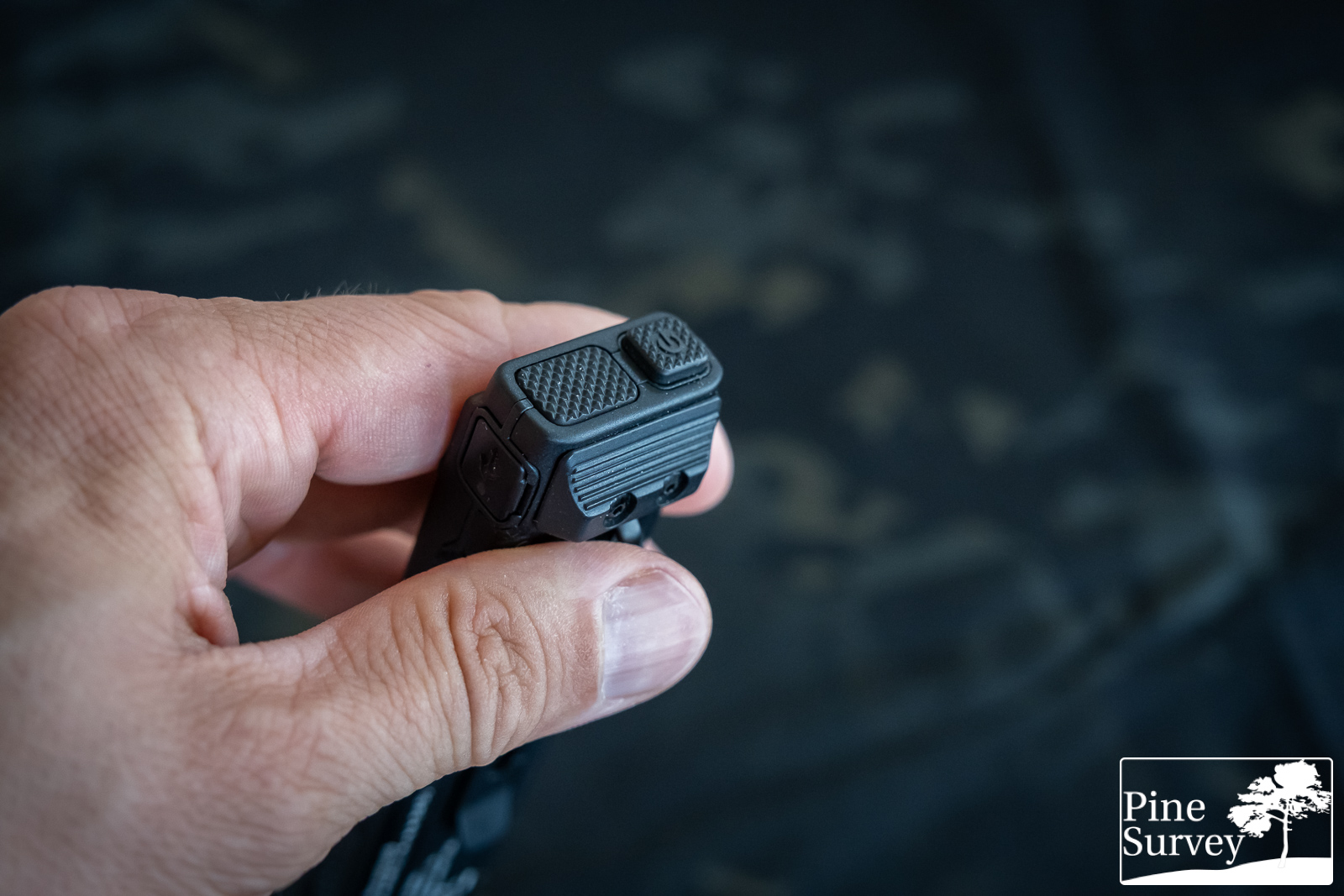
The five output levels are as follows:
- Ultralow: 15 lumens – up to 55 h runtime
- Low: 65 lumens – up to 14 h runtime
- Mid: 200 lumens – up to 4 h 15 min runtime
- High: 1,000 lumens – up to 1 h 30 min runtime
- Turbo: 3,000 lumens (momentary / short duration)
- Strobe: 3,000 lumens (randomly changing frequency)
When the lamp is switched off, a half-press of the power button activates Ultralow directly, which is a practical shortcut for situations where low-level illumination is needed quickly without cycling through higher modes. The lamp also features last-mode memory, recalling the previously used brightness level when powered on again.
The indicators embedded in the body display both the remaining battery level and the currently selected output level, giving the user a quick status overview at any time. This replaces the OLED display found on earlier models such as the EDC27.
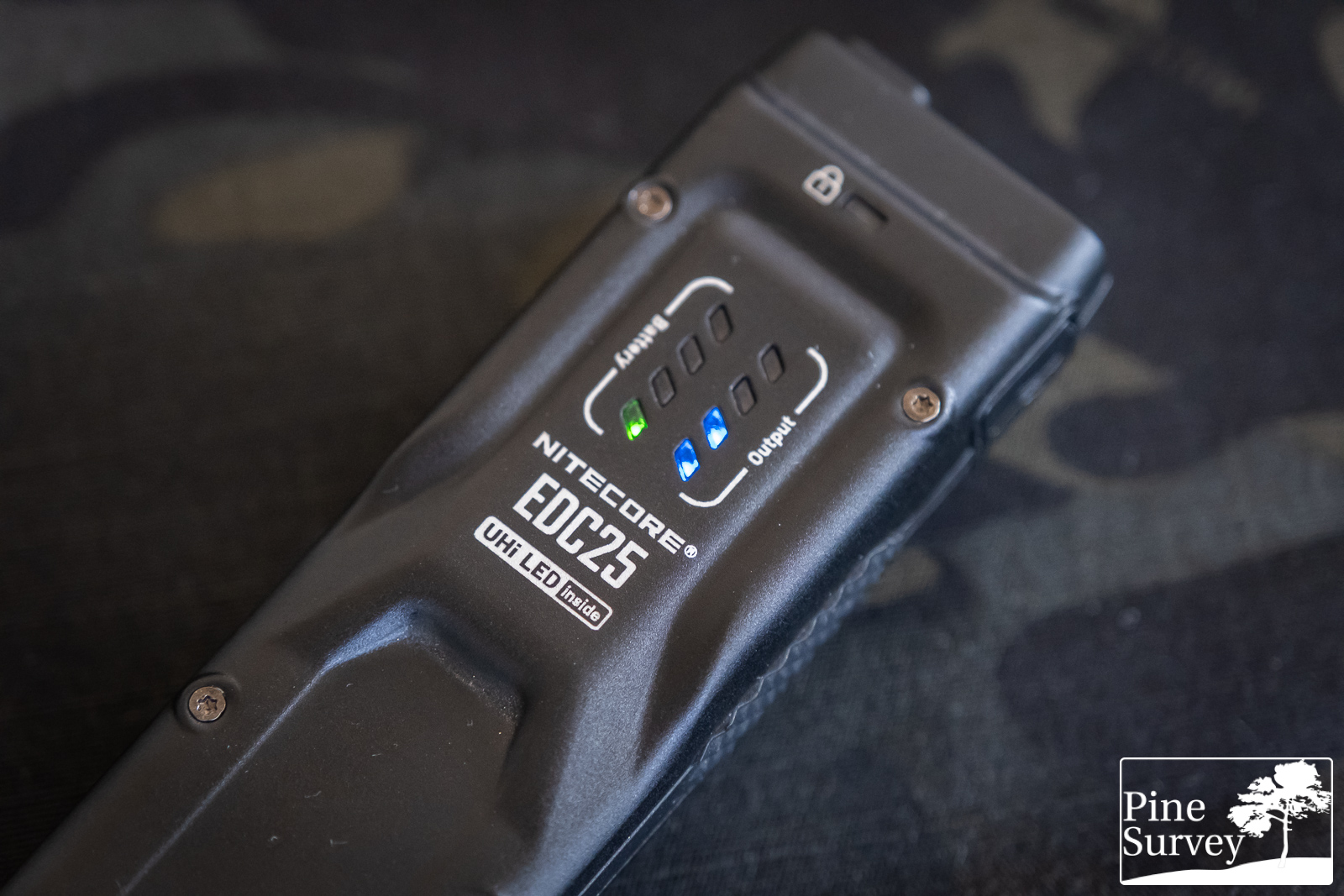
Lockout Modes
The EDC25 features two lockout modes to prevent accidental activation, which is a relevant consideration given that the lamp is designed to be carried in a pocket or on a belt throughout the day.
The Half Lockout disables the main brightness modes via the power button, but still allows access to Turbo and Strobe through the customizable button. The Full Lockout disables all switches entirely, making it the appropriate choice when storing or transporting the lamp.
The EDC25 in Use
When I first saw the EDC25, I was immediately excited by its flat profile. This solved the main issue I always had with flashlights: the space they take up in your pockets. When you’re carrying other items as well, your pockets quickly become uncomfortably full.
The EDC25’s flat profile made this much better. Suddenly, I had more mobility and no awkward pressure points.
The UI of all Nitecore lamps is easy to use, and once you have learned to use one, you will find that they are all similar. The modes feature useful lumens, and bearing all the above in mind, the EDC25 really deserves its name.
That being said, it is also the first lamp for which I really need and use the lockout mode. The flat profile makes the lamp disappear in your pocket, but if you carry it like a folding knife, you’ll quickly realise how often you press the on/off button by mistake. Using the half lockout feature therefore makes perfect sense and helps conserve battery life. The internal battery is easy to charge via USB-C. While I know there are people who prefer flashlights with replaceable batteries, I have never had a problem with Nitecore’s built-in ones.
After two years of use, this is actually one of my go-to flashlights, while others end up in storage over time.
Beamshots – Nitecore EDC25
As always, let’s add some beamshots to give you guys an idea about the EDC25’s performance. The following pictures were taken with 16mm focal length and starting with an automatic ISO (that goes up to 12800), f / 4 with a shutter speed of 1.0 sec.
The higher the modes, the lesser the ISO was dialed in by the camera.
For whatever reason the camera switched to ISO 800 during Ultra Low (15 Lumens). In Low Mode (65 Lumens) it started to adjust to ISO 8000. It then switched to ISO 3200 during the Mid Mode (200 Lumens) and to ISO 1250 during the High Mode (1000 Lumens).
When engaging the Turbo (3000 Lumens), the automatic setting even switched to ISO 800.
Single, max. output with Turbo Mode
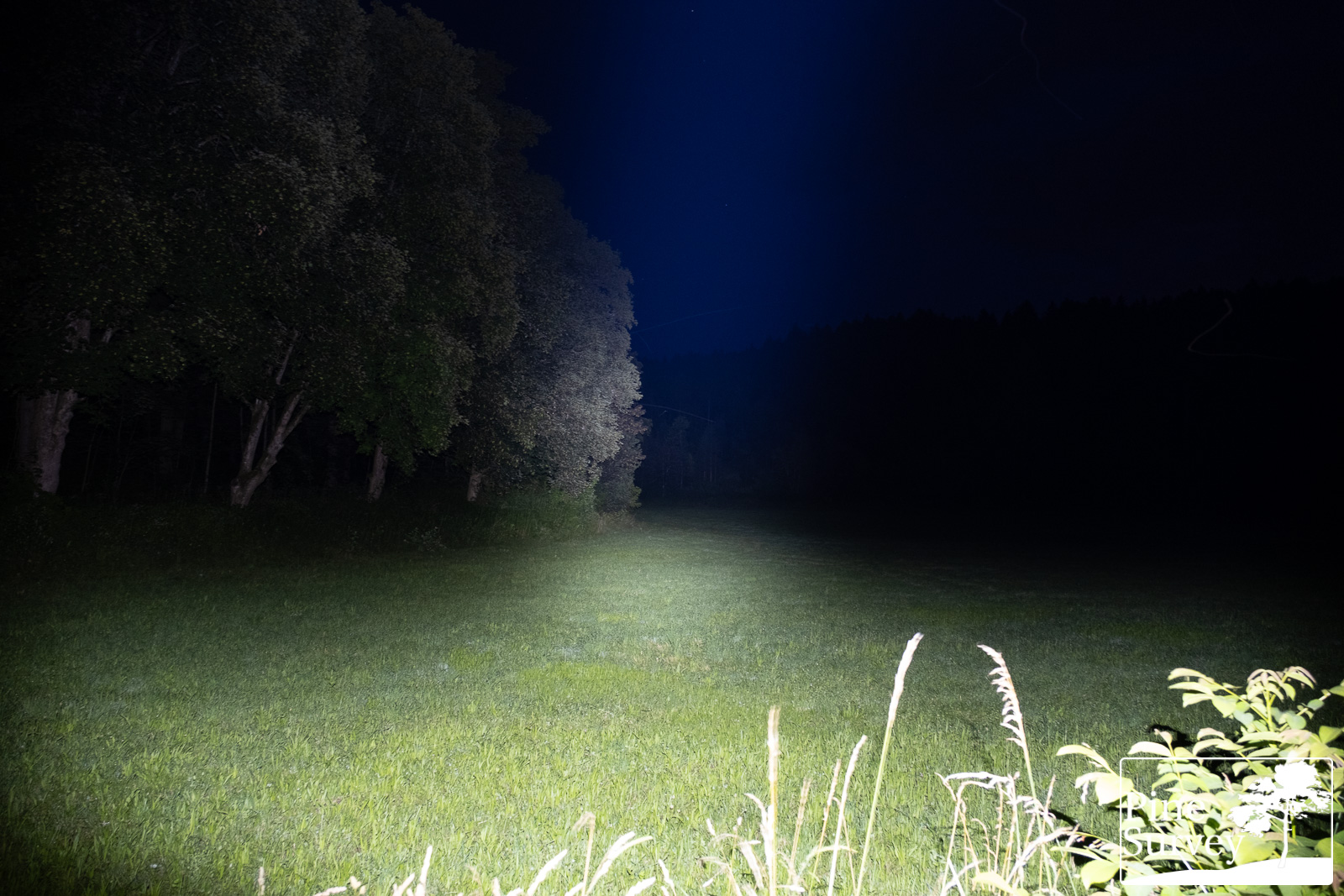
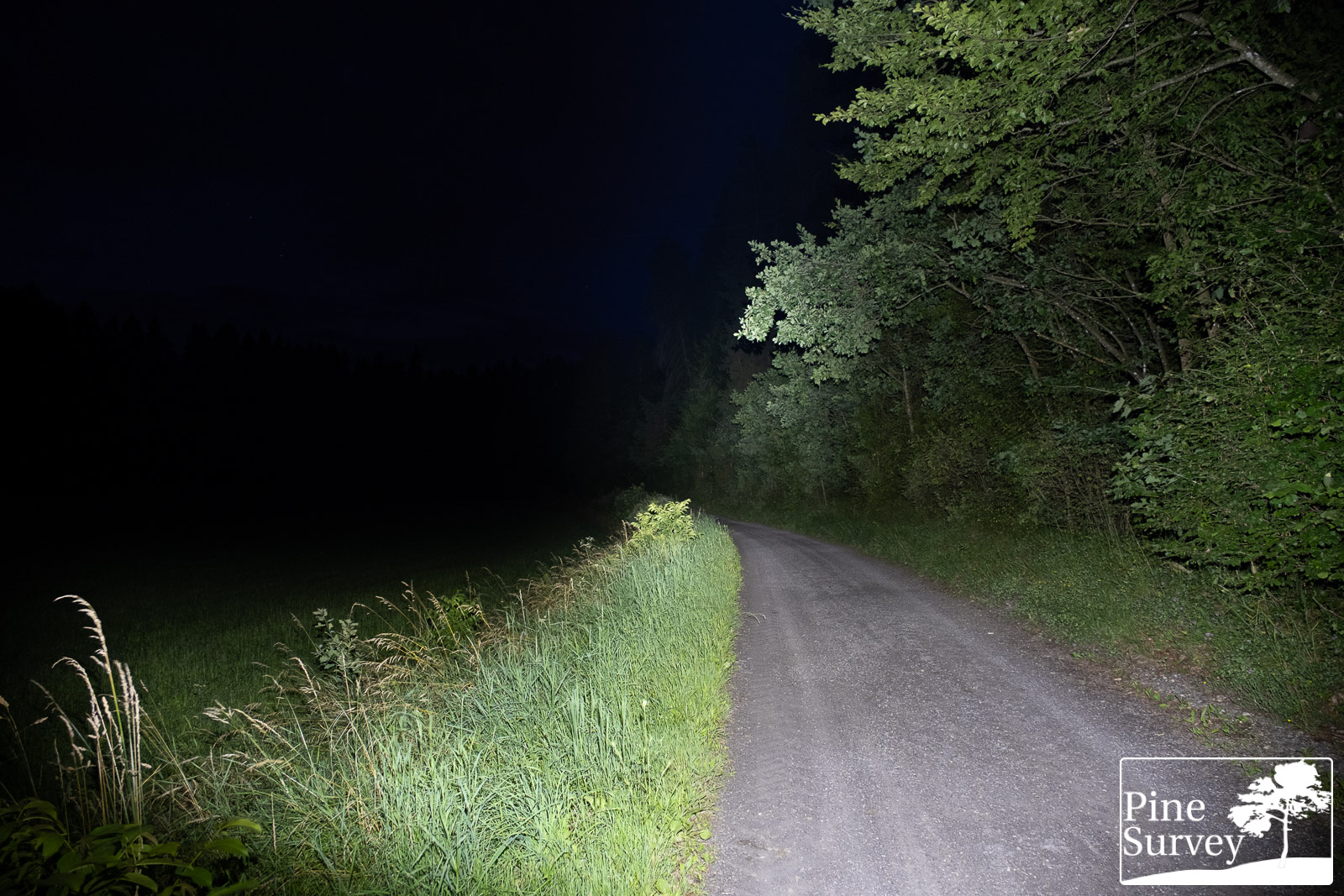
These two pictures show the lamp with the 3000 Lumens Turbo Mode illuminating a field and the street next to it. While the beam is directed at the center of the field, roughly 100m away, the trees in the distance are 200m from the camera and are clearly visible. The street itself is clearly visible and lit as during the daytime.
Tree Target
The following pictures show the spot of the Nitecore EDC25 directed at a large tree roughly 30m away.
The Ultra Low setting (15 Lumens) provides just enough light to see the tree, without giving attention to the flashlight and its user. Adding to that, it is very comfortable to the eye, making a change between dark and illumination very easy.
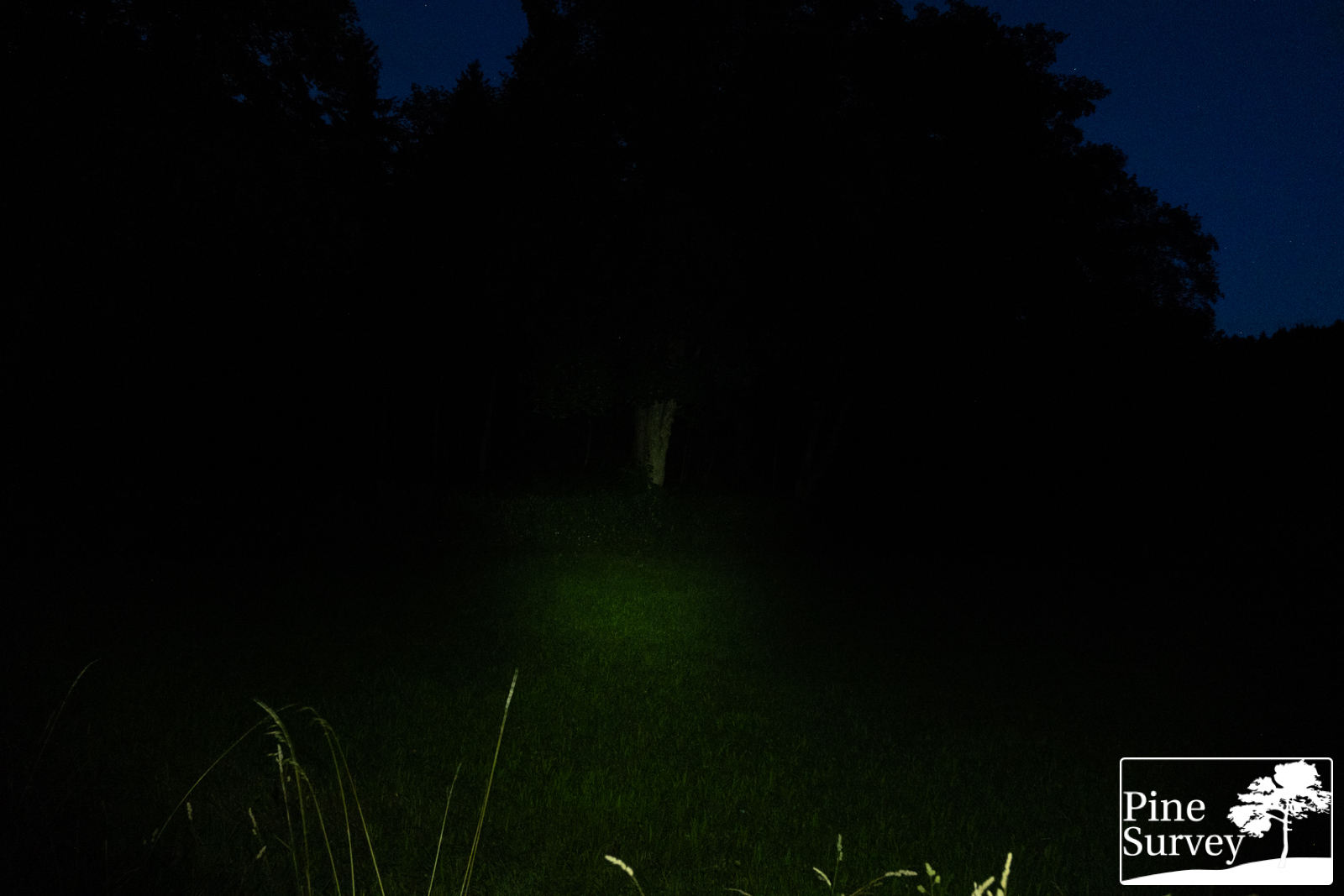
Changing to 65 Lumens of the Low setting, the tree is clearly visible, as well as the vegetation next to it. The area in front of the tree is illuminated as well. Judging from that, the power of the EDC25 is strong enough to navigate in the dark without putting too much stress on the eyes.
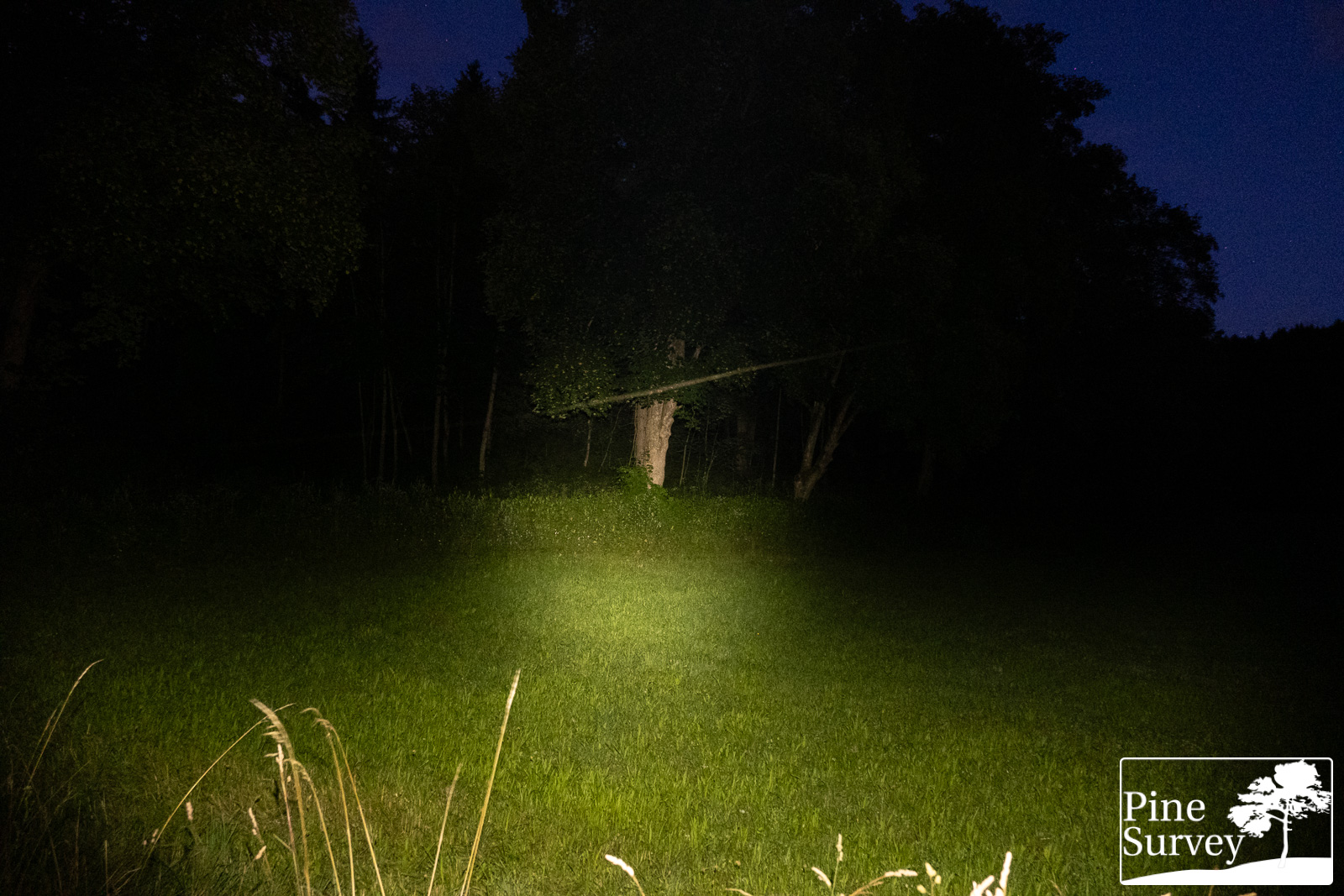
The Mid Setting with 200 Lumens strongly illuminates a wide area. The spot is clear and very bright on the tree and the beam evenly distributes light in the vicinity.
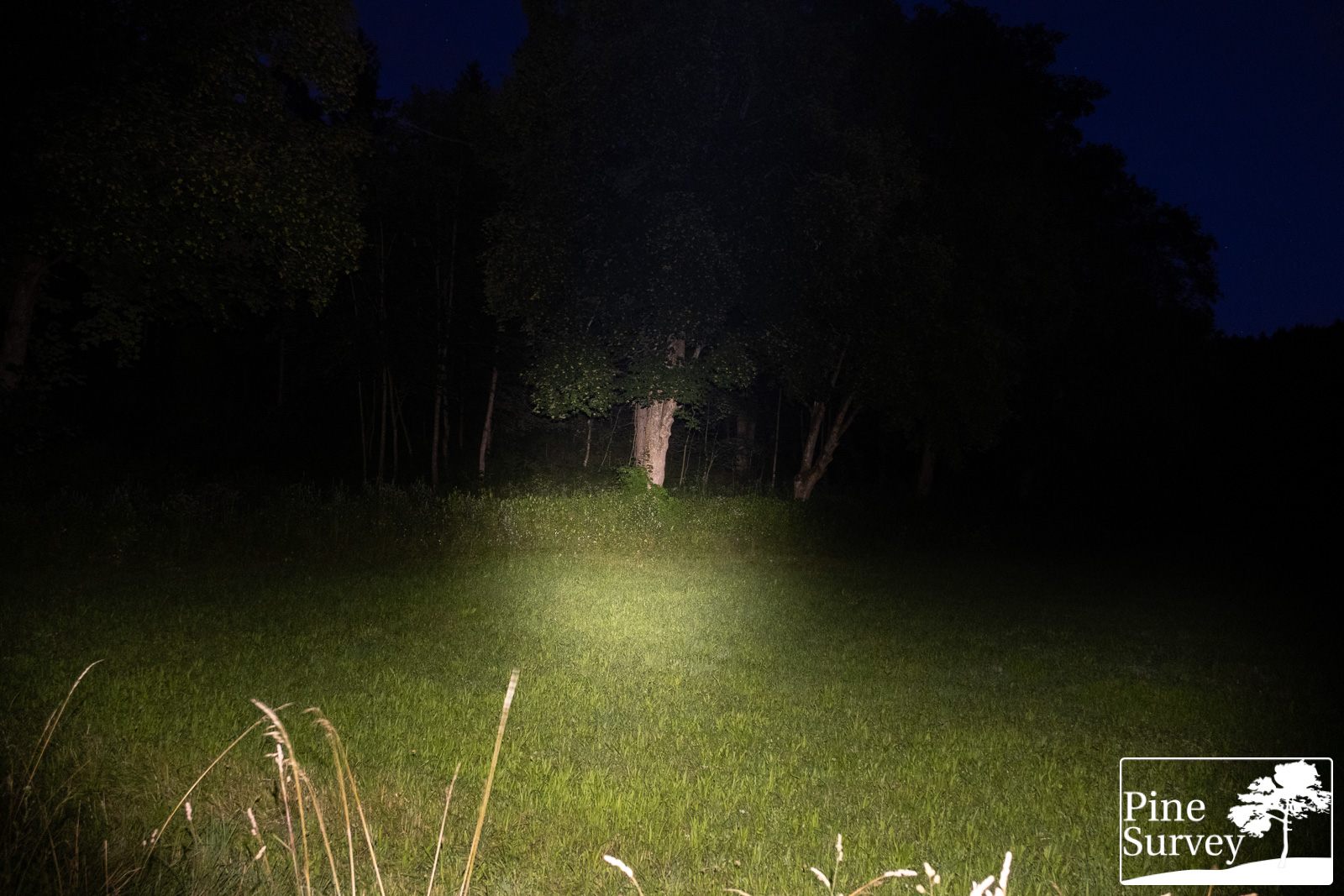
The High mode with 1000 Lumens at this distance shows a vast increase in brightness on the tree. The beam is less visible because of the overall high output, but increases in brightness as well. You can actually see the beam also in the upper middle of the picture aiming down on the base of the tree.
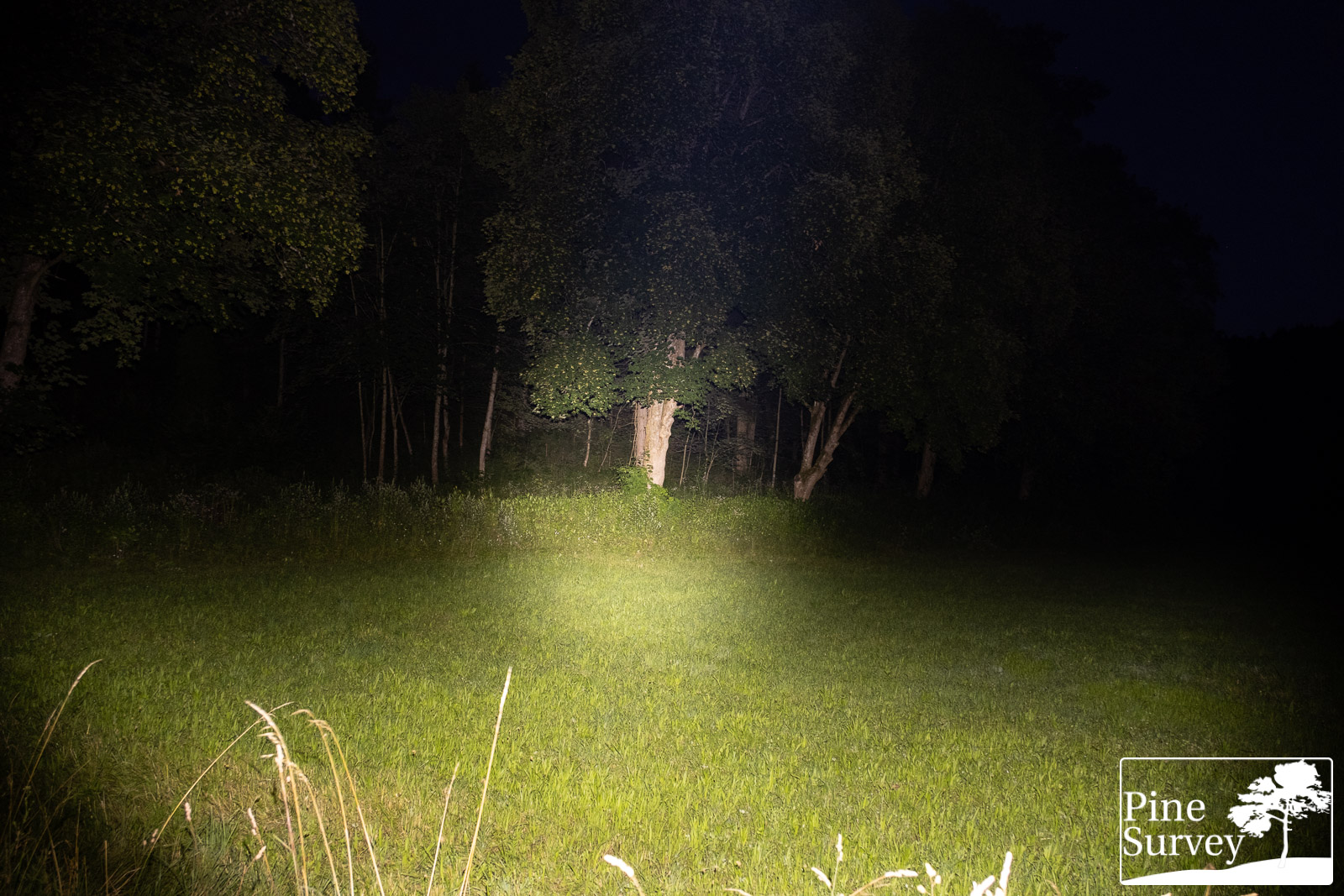
Switching to the Turbo Mode (3000 Lumens) shows a noticeable difference in the beam. It is more pronounced and stronger and has a blinding effect at this short distance.
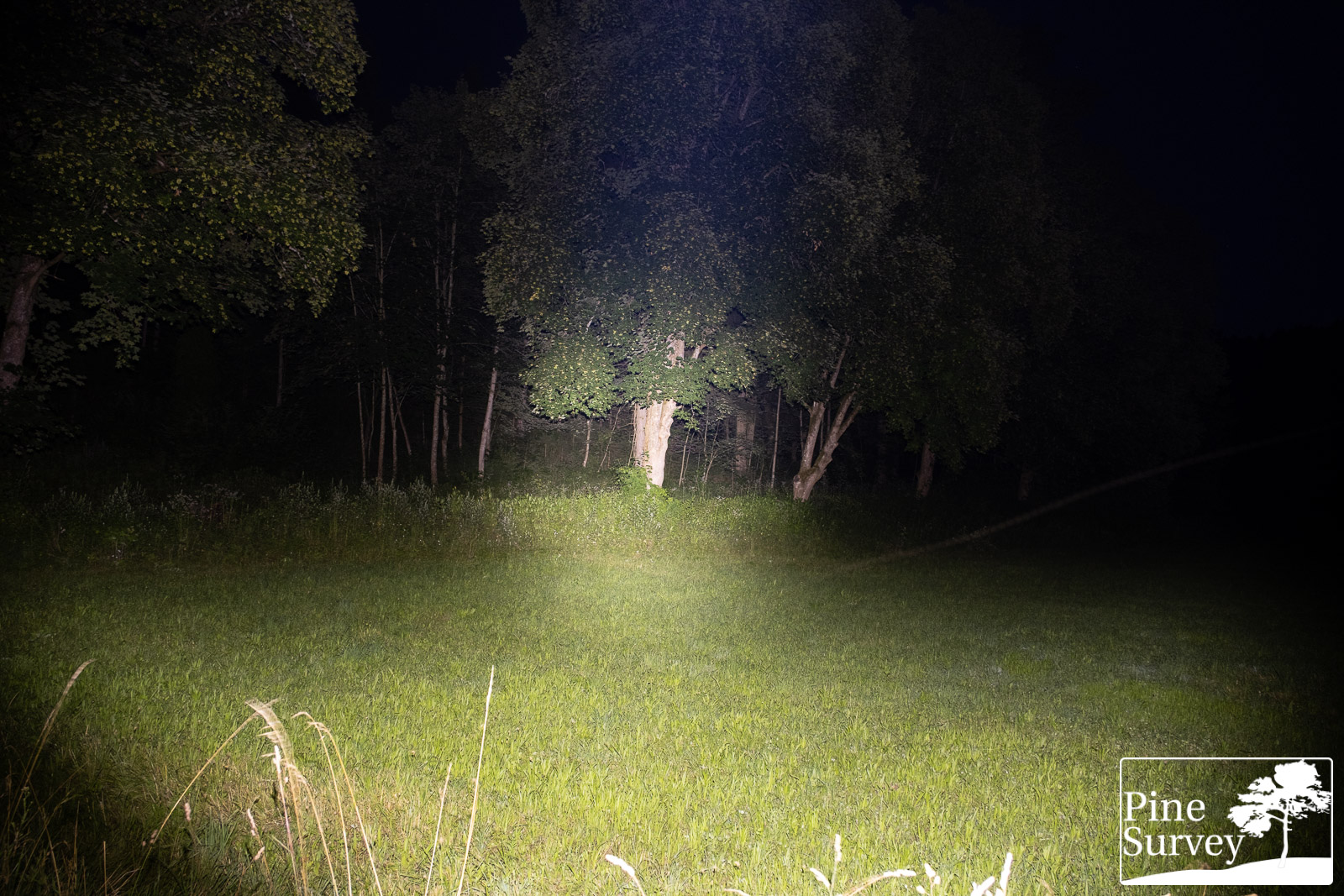
Directly on the floor
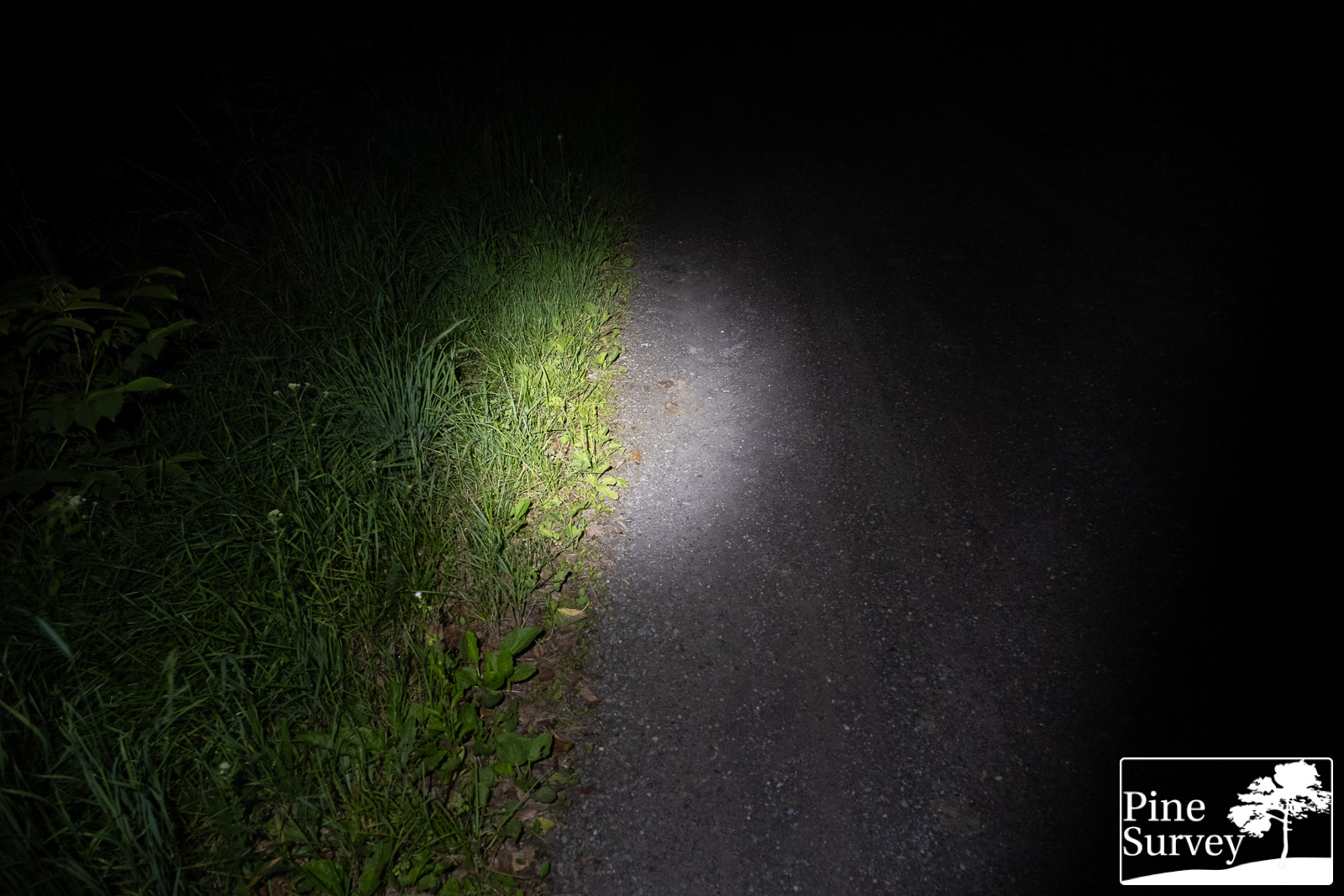
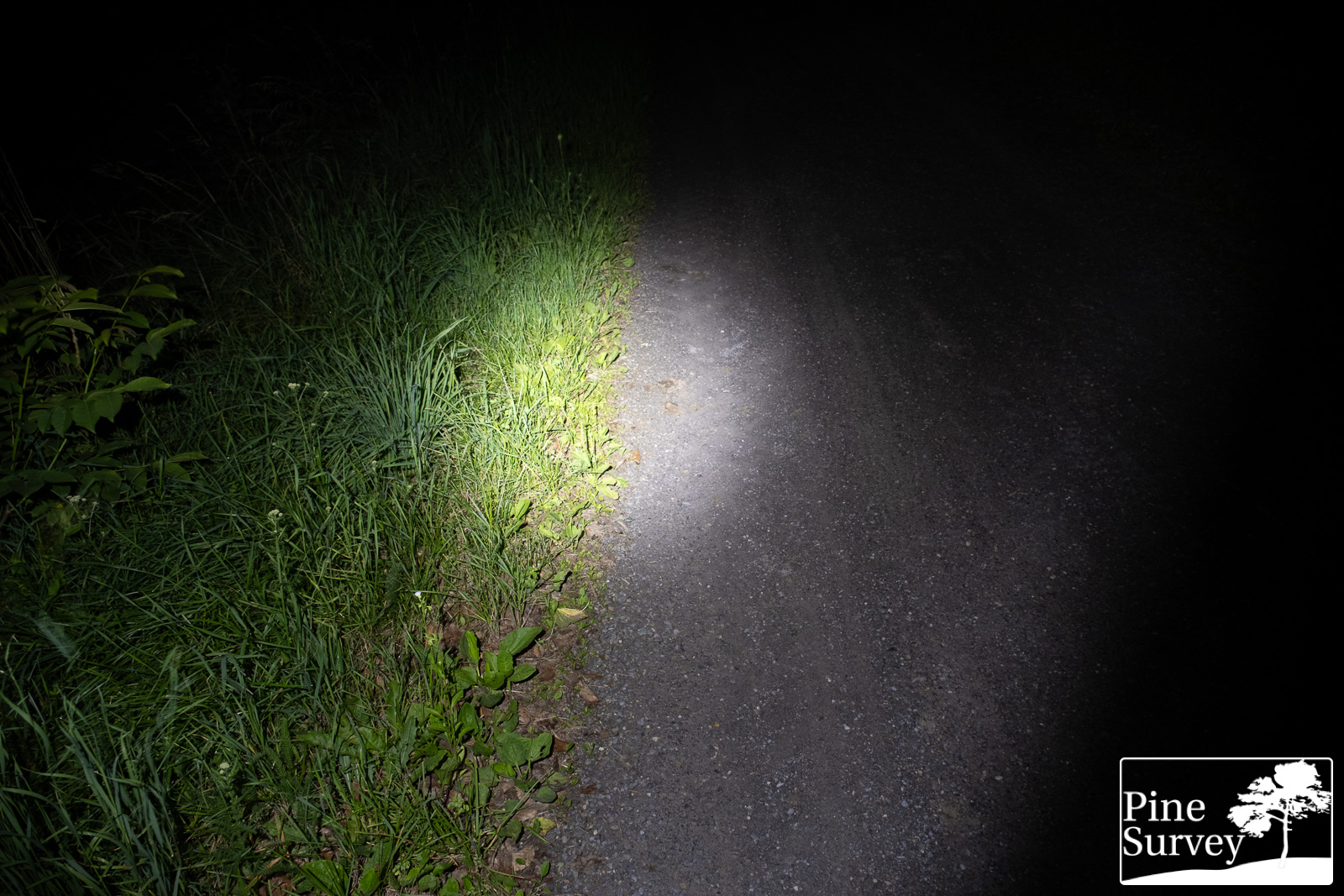
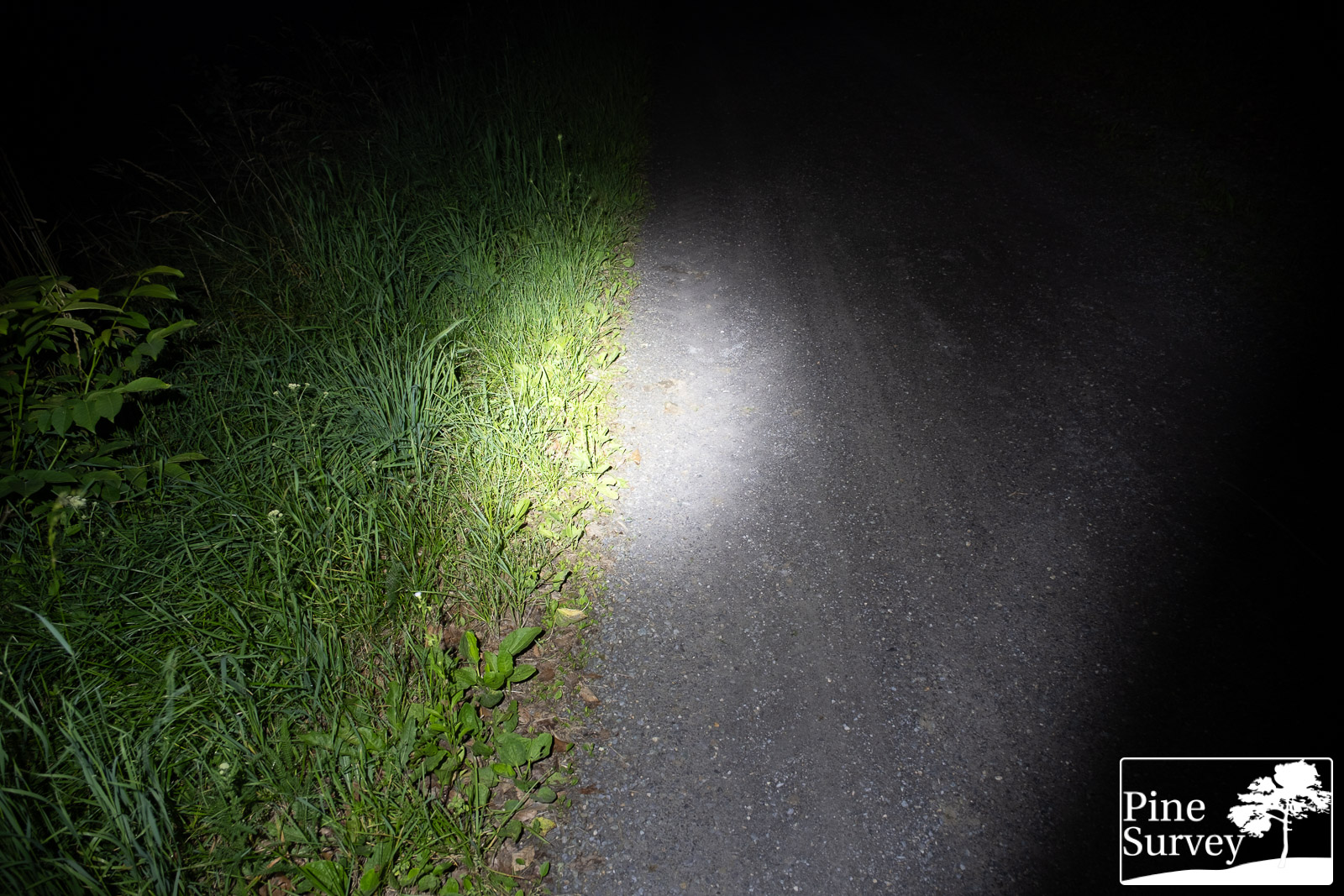
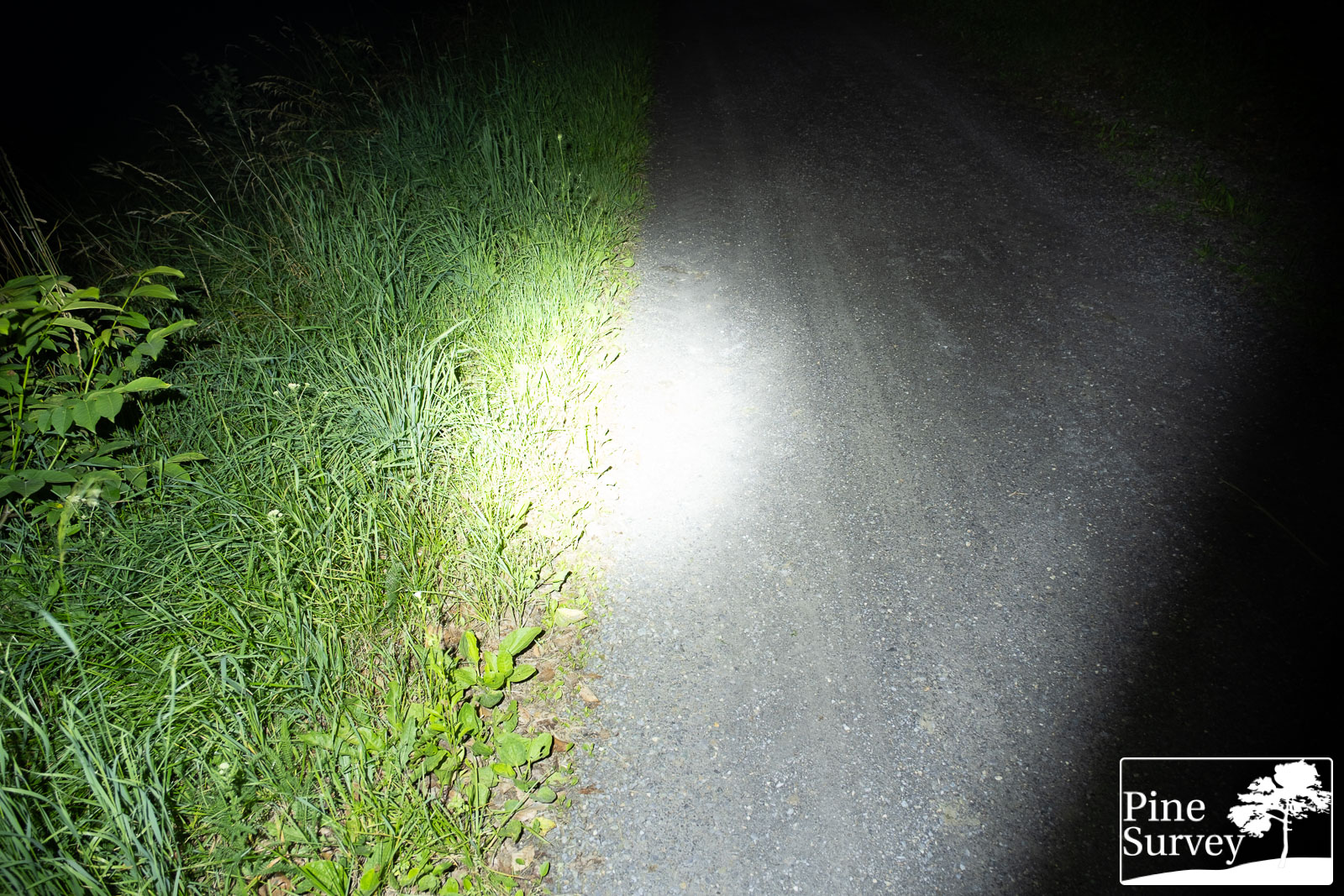
The last beamshots show the spot and beam when directly aimed at the ground below. The change between the settings already looks drastic in the pictures. Additionally one has to bear in mind that the camera changed ISO settings to accommodate to the brightness.
So after the second picture, the camera changed from ISO 1600 to ISO 640 during Low Mode and then to ISO 250 and 160 during Mid and High Mode.
Conclusion
The Nitecore EDC25 is a well-thought-out evolution within the EDC series. The flat, slim form factor is genuinely distinctive and makes it a convincing companion for daily carry, particularly for those who find conventional cylindrical flashlights too bulky for pocket carry. The combination of up to 3,000 lumens, a 300-meter throw, and a weight of 104 grams is impressive given the constraints of the design.
The construction quality reflects what Nitecore has delivered consistently in this price range: clean machining, a durable hard-anodized finish, and a user interface that is intuitive from the first use. The dual-switch layout, the customizable tactical button, and the dual lockout system all contribute to a lamp that works well both in an everyday carry context and in more demanding situations.
The built-in battery and the IP54 rating are the two points where users may have reservations. For the former, USB-C charging is convenient and fast, and the argument for a fixed battery in an EDC context is reasonable. For the latter, the splash resistance is adequate for most everyday scenarios, but those working in consistently wet environments should weigh this against alternatives with higher ingress protection ratings. Personally I never ran into issues regarding these two points.
With that being said, the EDC25 is a compact, capable, and well-made flashlight that makes a strong case for the flat form factor as a practical choice for everyday carry.
Many thanks to Nitecore for making this review possible!
Thank you for reading!
Take Care!